Tuesday, May 20, 2008

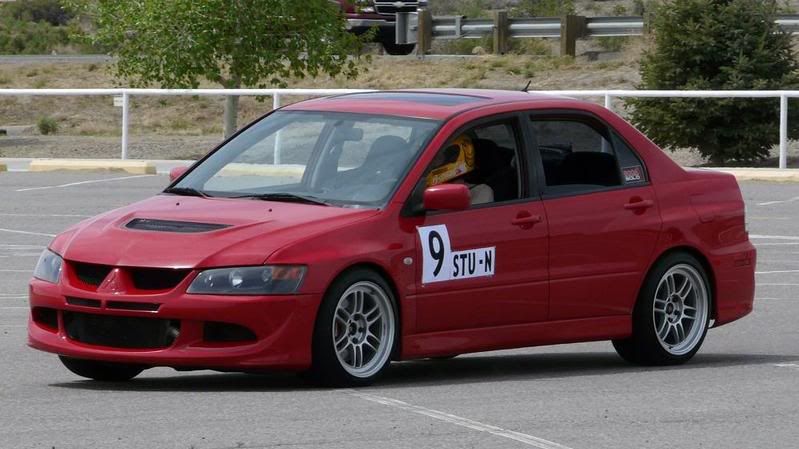
SCCA Rocky Mountain Divisionals


All event photos were shot by Gabriel Mendoza. He is another local autocrosser who drives his Focus very well in STS.


"They give trophies for second place Novice?"
Too much to write everything about it, but it was one of the best times I have ever had!

Wednesday, April 30, 2008

New Tires and STU Prep...

In lieu of the last two events and what I learned from them, I decided the best thing to do would be to take some power out of the vehicle, get some new and better tires, and get the car within STU rules. 
The car's power curve was very aggressive and peaky, with boost coming on quickly and almost violently, making the car harder to drive, and especially to learn on. Even in stock form, an Evo is overkill for a novice, and in the words of the announcer at the awards ceremony of the last autocross in Farmington "a handfull." This, combined with the sub-competitive and past-prime Azenis made the car rather, um, "exciting" to drive, but not in a good, fast grippy way. In an over-powered and under-tired, hard to modulate power, screaming and smoking tire, coming into every corner way too hot and plowing overheated front tires to compensate for it kind of way. I know this may sound sound like a blast to many, and it is for a few runs, but when you are trying to simplify things to focus on your driving, it's NOT. Especially as a beginner.
So off came the boost controller, and back in went the stock BCS, complete with boost pill for true stock-boost (Cameron verified that he had not changed any of the boost tables with my tune) and I reluctantly removed the superior IX MR diverter valve and replaced the crappy, leaky plastic VIII valve. I made arrangements to acquire a high flow cat to put in place of the test pipe, and so on... but the best part of getting under STU rules is...

NEW TIRES! Dunlop Direzza Z1 Star Spec. 245/40/17, as is the STU standard. Along with the Advan Neova AD07 and Bridgestone Re01R, this is one of the top 3 nationally competitive street tires for autocross. The Advans, though the fastest, are literally double the cost of the Dunlops, and prices on the RE01R soared from a competitive $153/tire to $205/tire, and had not been proven to be any better in fact *possibly* inferior in *some* areas of performance), sothat combined with the fact they placed first at national tours immediately upon their releasemade it a clear choice for me.  I intended to get these sooner, but the first shipment sold out in less than two days and I missed it, so I made sure I would get ahold of the next shipment by any means necessary. 
Many people disapprove of a 245 tire on a 9.5" wide wheel like mine, but this was something I was well aware of and did intentionally. It may mean "less" effective and stiffer sidewall and quicker break-away of traction, but in theory it also means slightly more tire in contact with the ground, quicker response and less deflection, and slightly smaller overall diameter. suposedly a more stretched tire also requires less camber in order to reach it's maximum grip, but I don't have any hard proof of that. In addition, when the Evo first became available in the US, someone won nationals on the same setup, so I knew it couldn't be that bad. I knew the tire would be a bit stretched, but it was not as much as I expected. 
Now that I have enjoyed the benefit of how inferior street tires can amplify mistakes and poor driving technique, I feel that there is some much-needed grip to be gained and maybe even some unsprung weight to be lost by switching to a narrower, better compound tire. 
  

Thursday, April 24, 2008

RSW Time Attack @ SWMS 4.19.08

Last weekend I attended the second monthly Racing Southwest "DriftRoad Cross" at Sandia Motorsport Park. This is the event's first season, and it had a decent turn out. It was set up as a time trial, and the course consisted of a combination of a section of the road course and a very small and tight autocross section. The drifting took place on the inner oval of the track at the time time.
This was my first time on a road course so with this in mind I was not disappointed that the track setup was rather short and limited the top speed. Although the autocross course was so tight that it necessitated going all the way down to first gear, this proved to be somewhat of an equalizer between the bigger and higher powered cars that could have an advantage on the faster parts of the road course and the smaller more maneuverable lower powered cars that were well suited for the tight autocross section. Lucky for me, although my car is no a Mini or a Miata by any means, it still has a decent balance of power, traction for it's weight and size, and maneuverability. Evos are well known for excelling at both autocross and road racing, so I definitely wouldn't be able to use the car as an excuse. I was going to look bad in a good car that my driving skill or lack thereof could not even come close to taking full advantage of, and I was prepared for that.
Regarding other concerns of the car itself, I knew that my old Falken Azenis RT615 tires which had been in sub-freezing temps in my shed for the last two years were sufficient for spirited street driving and cautious road racing, they were less than ideal for pushing the limits of my and the car's abilities. This was a perfectly appropriate handicap though, as it caused me to drive all the more conservatively and pay more attention to getting acquainted with driving, the track, and my car. After all, I had no intention of actually racing today. This was to be an opportunity to test my patience, get the feeling of driving on an actual racetrack, become more familiar with my car and it's new suspension, and try to squeeze in a little bit more of all of the above before the next SCCA autocross event. In addition, having relatively limited grip of street tires also turned out to be very telling of my mistakes and showed me where I was upsetting the car too much by causing loss of traction.
Until this point, I had only driven the coilovers very gently on the street on all-season tires and about 5 autocross runs on the Azenis, and had not really tried all of the different settings. I started out with the same setup that had been recommended for good rotation in autocross (full soft in front, close to full-hard in back), which was more by accident of forgetting to back off the damping before my first lap. this proved to be WAY too loose, as the back end stepped out a few times in very "exciting" fashion at even light lifting of the throttle or braking during a turn. This also amplified the fact that my movements were too sudden and suffering from a reactive rather than anticipatory approach, and forced me to smoothen my inputs and do everything sooner than later.
The second lap I backed off the damping in the rear significantly, and this already helped reduce the excess oversteer immensely and get the car more neutral. I know that Evos are more known for understeering than oversteering, but I should mention that the coilovers have unusually high spring rates (as much as 875lb/15.5k I later found out!), and a hefty 26mm rear sway bar to boot (stock is 22mm!). Even after this adjustment the car was still prone to losing rear traction relatively easily. I don't know if it was due to becoming more familiar with the track, the damping adjustment, the tires beng warmed up, or all of the above (and it really doesn't matter) but I took a good amount of time off. I can't remember exactly how much, and the times have not been shared yet, so I all I can say is that it was significant. But times are almost irrelevant to the difference of how I and the car felt compared to the second run.
The most informative part of that run though, had nothing to do with the car at all. It was having Brenden Tolsch ride along. Brenden has been doing very well in his first season of autocrossing his S2000 at SCCA events and has some prior experience with HPDE's like this. Immediately following the run he had some very helpful feedback for me. I had been riding the inside of the turns too soon and too long, and not using the full width of the track enough. I needed to be going FAR wider at corner entry and allowing myself to go far wider at corner exit as well. His advice proved to be spot on, as I cut more than a second off of my previous lap.
Each lap (for total of about 8 or 9 if i remember correctly) I was able to shave off decent amounts of time and go from the pathetic and disgraceful time I started with to a less embarassing but still humbling lap time. I really wish I had times to reference and compare, but they were never posted and I have since forgotten exactly what they were, and don't want to post inaccurate speculation. What I do know is that my times went down consistently, and the difference in time cut off each consecutive lap grew even greater toward the end. Usually it's the other way around for me. It may be a good thing I don't have the times anyway, because they were indeed nothing to be proud nor ashamed of, but also were not the point of the whole event.
By the end of the night, I felt that I was just starting to get the hang of it after my last run, which is how it always goes. I came to the conclusion that in combination with my high spring rates, I simply have too much rear bar. Even under steady state cornering (where a rear stabilizer bar's effect is most noticeable) and constant and moderate throttle and steering through the turn, the rear end was losing traction too easily. While this could be desirable in autocross, it was not how I wanted the car at high speeds and on a faster, bugger, more open racetrack. Combined with the fact that even at the last autocross I felt that the car was too skittish and oversteered too much, led me to believe that changing the bar to a softer setting or replacing it with the stock one would be desirable. However, that is a change I wanted to feel without too many other variables at the same time, and I already had some other more important variables in the works for the near future ;)

Monday, April 14, 2008

SCCA Autocross #2/3, Farmington, NM

Although I missed the first local SCCA region event of the season, I had the car somewhat close to "ready" just in time for the second and third events of the season at a 2-day SCCA autocross event in Farmington, NM. This was my first autocross since my very first, which was way back in August of '06. Needless to say I was pretty green to begin with, and given the last minute nature of deciding to go, combined with several other factors, it was a little bit hectic. I almost bailed on the event completely after discovering that the inboard sidewall of one of my tires had some material shaved off from a damaged part that had been rubbing on it. After closer inspection and a few second opinions, I decided to run the tires anyway.
Farmington is about 200 miles from Santa Fe, and I could not spend more than one night in a hotel so that meant leaving the morning of the event. Luck would have it that while I was trying to change back to my all-season tires on the stock wheels for the drive and do other preparations to the car, a freak spring snowstorm rolled in literally at the exact same time that I began working on the car outside. Since I still do not have a garage, this meant rushing in the snowy cold before it got completely dark. The next morning I had the pleasure of waking up at 4:15 AM to see two inches of snow on my "race car." Ah, the joys of low-budget amateur racing...
The first day of the weekend's "racing" went even less smoothly than my first ever in '06. Maybe it was the sleep deprivation, the bad news about my father's health that I received on the way up, simply the nature of being a beginner, or more likely a combination of these. Simply put, I was NOT on my game, even with my inexperience taken into account. My first event in '06, I had been able to study and memorize a course map days in advance, and had the time to read the Solo II Novice Handbook, (the majority of it's contents I had forgotten in the meantime) and had a friend there to provide encouragement and support. I did not have the benefit of any of these helpful things this time around, but that is good for me. After all, this event was not going to be about being competitive, it was about soaking up as much experience as possible to make future events go smoother, getting the hang of the structure of the event, becoming more familiar with my car and how to set it up properly, and just having fun.
Due to the fact that I had a test pipe (no catalytic converter), 255 width tires, a boost controller, Evo IX diverter valve, and higher flowing fuel pump, I was beyond the specification limits of STU, which would have been a more appropriate class for me to be in. I knew this before hand, but did not get around to spending the time and money to get under STU-spec. Instead I was in the next highest class for my car, BSP, with the class modifier of Novice, a rather ridiculous combo, since BSP allows for unlimited size race tires and unlimited fuel, and many BSP cars are prepared far beyond what the typical novice is capable of taking full advantage of. Classing was not important at this point though. It's not as if I were going to show up to my first event and start collecting leading points in any class. Still, I felt a bit silly with "BSP-N" on the side of my car and having it announced over the PA system every run. I wished I had started with a stock Evo, or perhaps even slower, inferior car more suitable for a beginner. But only for a second ;)
I knew my alignment (see December'07 post below) wasn't ideal for autocross, but was not sure how I should set it up by myself at the venue, especially lacking camber and toe measuring tools so I left it alone for that day, and to use it as a point of reference for future changes. My sloppy driving, or more specifically my totally incorrect timing and amount of inputs and poor navigation of the course would have rendered most improvements to the car negligible in lap time results anyway. By the end of the day though, it became clear that I needed more front grip. The street alignment I was using simply did not have enough front camber and thus not enough front grip for me to keep the car turning where I wanted it to.
The course was relatively fast and technical, as most agreed. 70mph top speed and possibly even a brief touch of third gear were not completely out of the question. It featured the typical autocross slalom and hard 90 degree turns as well as some nice sweepers, but was on a graded incline, and also had relatively long straights. Long straights mean it was easy and fast right? Wrong. This meant that even and especially if you had a powerful car like mine, you had to exercise strategic and efficient braking. Any speed or time gained in the straights was only as good as your ability to slow down and carry speed through the next turn, so it really didn't do much good to be a beginner in a fast car like me. That is always the case, but this course really leaned heavily on it.
Good times for the day ranged from a 56"s in EM to low 60"s in many other classes. My best time of the day was a pathetic and Evo-unworthy 66.54", and that was one of my few clean runs. I also managed THREE DNFs from missing a gate several runs in a row until someone asked me if I knew where I was DNFing. I just replied "I am DNFing?" Spectacular and genius. I also had several other coned runs, and a few times I almost came to a complete stop while fighting the car every way possible (turning, brakes, throttle, you name it). Yup, I SUCKED, badly.
I monitored and adjusted my tire pressure obsessively, probably more than mattered for the day and my lack of skill. This did help a little though, and proved to be an investment in information I could use in the future. The biggest of many mistakes I made throughout the day were having too heavy of a foot on the throttle, and gently riding the brakes far too long every chance I got. That is, until some people made some suggestions that I took to literally, and I rode in some other types of vehicles, the driving techniques of which I tried to emulate, but discovered simply did not apply to my car. A FWD, AWD, and RWD car, especially of greatly varying power levels and curb weight, all have at least a slightly different (and at most almost the opposite) optimal racing line, point of braking before a turn, etc.
The day really was about overcoming the major anxiety I was experiencing, learning how the event works, how the track works and how to work the track, learning what tire pressure to use, what alignment settings to use, and what to absolutely not do in driving. But it was still fun, and did manage to start improving a tiny bit at the very end. I felt like I was learning to walk or read again...
Day two of the 2-day race weekend was a bit better. Not so much in terms of my times (although they were slightly better), but more in terms of mental state, knowing what to expect, how to properly set up my car, and finally, make some improvements in my driving somewhere in between all the rest. The course was very similar, but backwards of the day before, seemed a bit easier, and was definitely faster.
Fastest times of the day were 51"s in EM class, with 56"-58"s being competitive in other popular classes and my best of the day was a 61.324. I managed not to DNF any runs this time, but hit even more cones than the day before, as many as two on a few runs. Having added -1 degrees of front camber and about 1/16" of toe-out made the car much easier to get going where I wanted it, predictably. While I struggled and did not get good times, I was not as far off from the other and better novice drivers' times as I was the day before. It always seems I start to finally get the hang of it right on my last run. I get the feeling that this is just a fact of autocrossing or racing in general, and is why we get addicted and keep coming back...

Monday, March 3, 2008

New Wheels!

I bought some new wheels. Enkei RPF1 17x9.5 and they weigh in at around 16.5lbs each. Since the best offset I can get for these while still being able to rotate them is +38, I had to use Project Kics 20mm spacers with built in studs on my front hubs. This of course widens the front track by +40mm, which actually helps with turn-in. Since I have had all-season Kumho Ecsta ASX tires on my stock wheels and had my old Falken Azenis RT-615 255/40/17s lying around, I put the Falkens on the new wheels.
The Project Kics spacers bolt on to your existing wheel studs, and have new studs built into them. This seems like a bit of a risky setup at first but is pretty commonly used and if you stay up on checking the torque on all the nuts regularly they should be safe. One of the only real drawbacks is that they stick out far enough that you the hub center no longer protrudes and therefore the wheel is no longer supported by the hub center, but by the studs themselves. at first the thought of this is frightening, but the fact is even the stock Evo wheels aren't perfectly hub centric either.
While setting the car up at an event, I found that even at around 115-128 nM (my torque wrench has indicators for 115 and 128 or something, so i had it somewhere in between, and IIRC the Kics instructions specifified around 116 or 118nM) the nuts were considerably loose. not surprising considering I had put almost 1000 hard miles (including racing) on the car since I installed them, but I am glad I checked. While I was torquing them, the wrench would click to indicate that the toque had been met, but the nut would continue to move for as much as another 45 degrees! So I just continued to ratchet them down, and raised the tq. to somewhere around 130nM. I know I should have checked them sooner and kept track of exact tq. specs, but you know how it is when you are in the pits, and are missing the driver's walk/meeting, and are in a hurry.

Bottom line, check the tq. on the spacer nuts within less than 100 miles or significant driving after installation, and continue to check them regularly!

Pics to follow shortly